Disclosure: I sometimes earn products or commissions from affiliate links or partnerships on my blog. I only recommend products and services I trust to serve you. Learn more.
Part of living off the grid is designing a life that doesn’t use all that much power. What can you reasonably get away with? What can you do without? What can’t you do without?
When we lived in a “normal house”, we ran fridges and deep freezers, central heating and air, a microwave, a full-sized washer and dryer, and numerous small devices that used a lot of power, like hair dryers and clothes irons. We never thought about what was running simultaneously. We never stopped to wonder if our battery bank had enough to run the AC all night. We just ran things and paid the electric bill later. Easy peasy.
But living off the grid with solar power is more involved than that. There are things we consider on a daily basis that we never thought about back in town with our electric bill.
This post began as a sub-point on this post about what we wish we’d known before going off-grid with solar, which I highly recommend reading too.
But in this post, we’re going to explore what our off-grid house actually uses in terms of solar power. I’ll also provide some data and some points to consider if you’re thinking of making the jump to off-grid solar power.
- Our System Stats (as of Summer 2026)
- Our Home Design Stats
- Our Power Usage Month by Month (and how it compares)
- What We Do (and Don't) Run
- How We Think About Power on a Daily Basis
- Just Shifting Everything to Solar vs. Designing a Low-Energy Home
- The Irony of Our Low-Power Life
- Lessons Learned
- Other solar and off-grid posts
Our System Stats (as of Summer 2026)
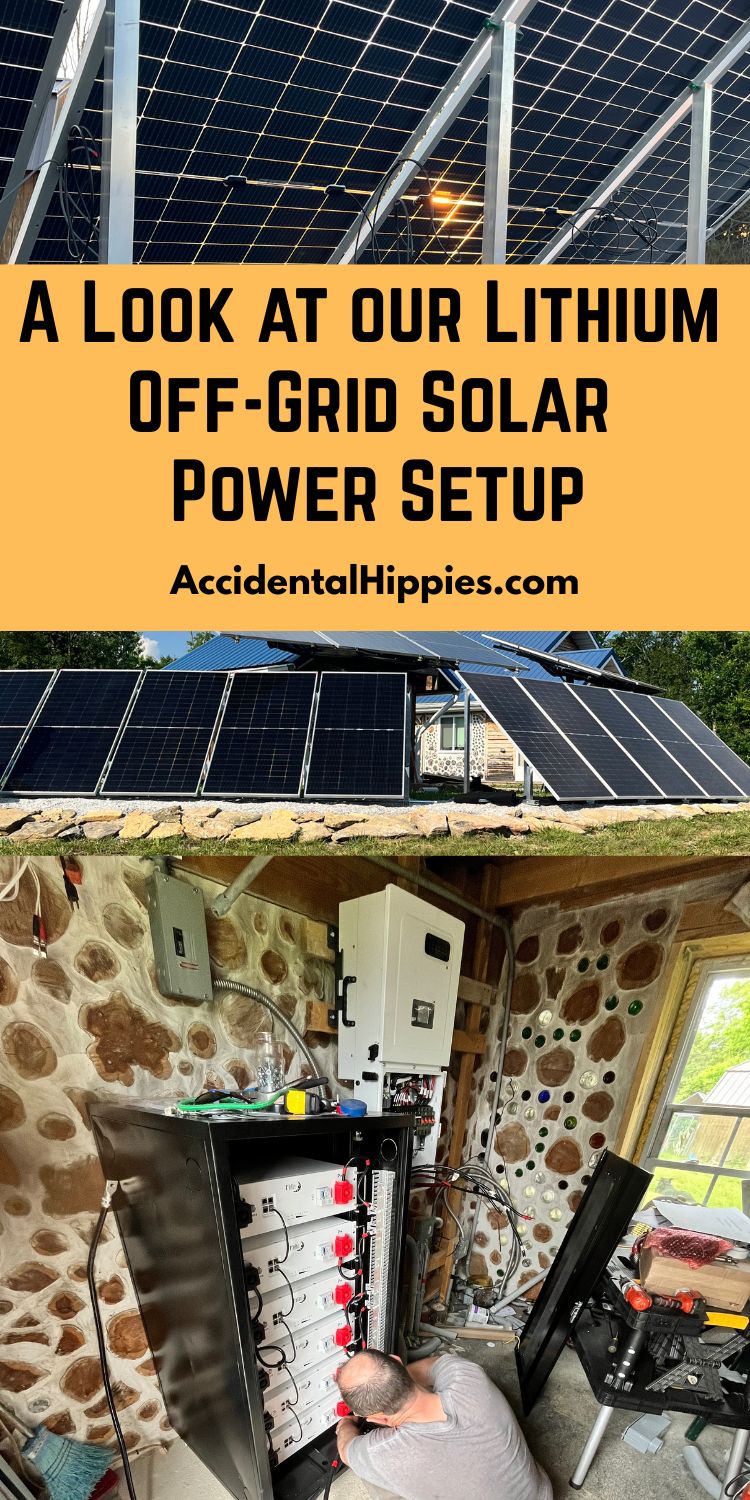
- BATTERY CAPACITY: 30.72 kWh via 6 – Midnite 5.12 kWh MNPowerFlo5 LiFePO4 batteries in a lockable EG4 cabinet
- SOLAR PANELS: 6,490 watts of solar panels, consisting of:
- 10 – 535w Jinko bi-facial solar panels
- 6 – 190w Jinko solar panels (from our original system)
- BATTERY MANAGEMENT SYSTEM: Midnite The One 11.4kW AC Output Hybrid All-in-One Inverter
Our Home Design Stats
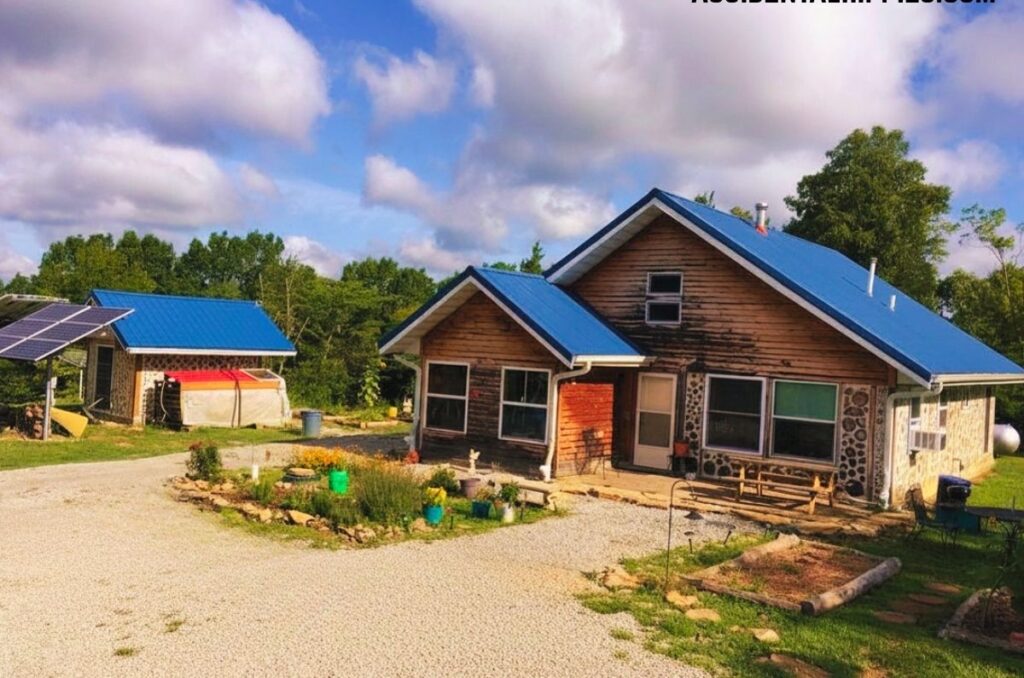
- Roughly 1,190 square feet of living space, with 2 bedrooms, 2 bathrooms, open-concept living room and kitchen on the first floor, and a loft room on the second floor.
- Our walls are made from cordwood masonry, which are very thermically efficient.
- The house is oriented north-south and is designed with passive solar principles, including large windows on the south face and few on the north.
You can get a better overview of our home build here.
Our Power Usage Month by Month (and how it compares)
Our Midnite inverter keeps track of our power usage, which we can access in an app on our phones. I took all of our data from June 2025 to May 2026, which covers our first full year of system usage, and this is what I found:
| Month | Usage (in kWh) |
| June 2025 | 217 |
| July 2025 | 389 |
| August 2025 | 266 |
| September 2025 | 110 |
| October 2025 | 82 |
| November 2025 | 110 |
| December 2025 | 183 |
| January 2026 | 233 |
| February 2026 | 179 |
| March 2026 | 102 |
| April 2026 | 75 |
| May 2026 | 102 |
| TOTAL kWh used | 2048 |
| AVERAGE kWh used | 170.6666667 |
You can see the seasonal fluctuations more easily in the bar graph below. Note the peaks of summer and winter. Our summer usage is greater because we run an electric air conditioner but not an equivalent heater during the winter.
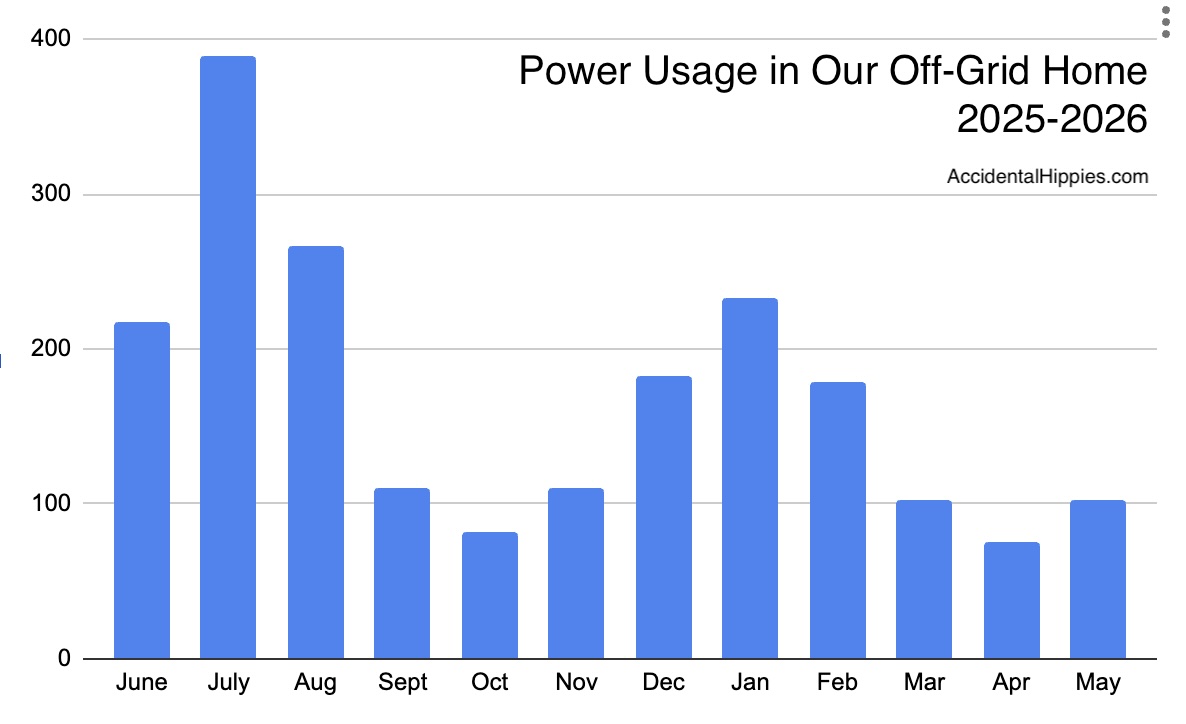
By contrast, a house similarly sized to ours in our region uses about 600 kWh per month on average. Compared to our average of roughly 171 kWh, we use 28.5% of the state average electrical power. You can use a site like StateCalc to find similar averages for utility use in your area.
What We Do (and Don’t) Run
Our new system is so robust that I could practically run all of these items at once if I wanted to. We use the following on a regular basis:
- Air Conditioners (both a window unit downstairs and a freestanding unit upstairs)
- Standard refrigerator
- Wall-mounted heater (in the solar shed during the winter)
- Shallow well pump (for our cistern)
- Full-sized top-load HE washer
- In-floor radiant heating
- Numerous small electronics (computers, TV, phones, air filters, lights, clothes iron, hair dryer, Crockpot, hard-wired smoke detectors, etc.)
- Power tools (saws, drills, air compressors, etc.)
At this point, there are only a few larger loads that would give me pause, though we could technically run them:
- electric clothes dryer
- central heating/air
- fully electric car
My husband is bent on getting an electric car because his current job has a lengthy commute and offers free car charging onsite, but I have my reservations for any charging on our home system. Same with my reservations for an electric dryer or central air. We could technically handle some of those loads, but we aren’t really set up for them. Alternatives I would consider are a propane dryer, mini-split air units, and a plug-in hybrid.
Other smaller appliances with any real draw, like a microwave, toaster, or air fryer, I mostly avoid because I haven’t missed having them and lack the counter space anyway.
How We Think About Power on a Daily Basis
System Charge Through the Day
I tend to start each day by checking the Midnite app on my phone to see what percent the battery is at. Most days, we tend to start around 85-90% and are fully charged by around noon, even on cloudy days. The only days where we don’t gain so much are the winter days where it’s really rainy AND the clouds are dense and close to the ground. But even then, we tend to break even on power for the day. We have a backup generator but only used it a handful of times last year to keep the batteries from getting too low.
How We Think About Power Loads
I’ve gotten pretty used to thinking about how many high-wattage items are running at a time. Our old system could only send 4000 watts to the house at a given time, which is basically the window AC on Low and the cistern pump. Anything else pushed it close to the edge, and if we crossed that threshold, the whole system would turn off to prevent it from frying itself.
Our new lithium system has way more capacity in terms of how much the solar panels can generate, how much the batteries can run, and how much the inverter can send to the house at a time. I go through the big differences and break down the numbers in this post if you want to read more about it.
But even when we lived with our little system, we could run a surprising amount and still live a fairly “normal” middle-class life. I used my crockpot all the time. We have always had a regular clothes washer. We weren’t living by oil lamps at night or anything; we were watching Netflix! I wrote all about it back when that was all we had:
READ: What We Could Run on our Small 1.4 kW Solar System
Just Shifting Everything to Solar vs. Designing a Low-Energy Home
If you want to run your existing home entirely on solar, and you’re accustomed to having central heating/air, electric stoves and dryers, and all manner of high-energy appliances, you’ll need a way bigger system than in a home like ours, which was purpose-built for a low-energy lifestyle.
We went into this project with the understanding that we needed to audit and reduce our power loads. This was especially important because we knew we didn’t have the budget for an enormous solar system. It seemed obvious that we weren’t going to be installing a huge furnace and AC, using an electric dryer, or cooking with an electric stove.
In addition to reducing power loads, we also wanted to build a house that used less power by design. Cordwood masonry has a high level of thermal efficiency, which allows us to use less energy to keep the living space comfortable. We also employed some passive solar principles and sought a smaller layout overall.
Obviously, your circumstances will impact the kinds of shifts you’re able to make. Are you planning to build a new home or keep your current one? Do you have a very large or a very small budget for a solar system? Are you planning to charge one or more electric vehicles? What kinds of local codes and ordinances will impact your home and the system you can install?
READ: Beginner’s Guide to Building Permits and the Code for Owner-Builders
These are all super important questions to ask yourself as you determine what kind of system you might be working towards. Our free PDF solar planning guide is something we put together to help you audit your potential power needs. I keep this in our free PDF library for email subscribers, which you can access below:
The idea is that you take stock of every electric device in your home big and small. Examine how much power these items use, both in running watts, amps, and any starting surge wattage. Add those numbers up, and then ask yourself: what loads do we want to keep, shift to another fuel source, or eliminate entirely?
We initially shifted our refrigerator to propane (and have since bought an electric fridge, which was a crazy adventure you can read about here). Our heat comes jointly from our wood stove and our in-floor radiant heat system, which is powered by our propane water heater. Our stove/oven is also propane. Meanwhile, our air conditioner is a super-efficient inverter unit that sips power on all but the hottest days (and even then, it only pushes 1,000 watts).
The Irony of Our Low-Power Life
It struck me, as I was adding all of these numbers up, just how absurdly low our power bills would be if we had them. If power in our area is about $0.14 per kWh, our heaviest month of usage in July 2025 would have cost a grand total of $54.46, minus any surcharges, of course. In that sense, it’ll technically take us longer to recoup the costs of our solar power than it would if we were using the power we used to in town.
Then again, if we’d built a system that did a straight 1-to-1 match for our old usage, we would have paid way more for a much bigger system, so it probably would take the same time to recoup anyway.
Either way, we didn’t go into this to save money on our power bills. We’ve always been inclined towards alternative power and green living. The staggering $25,000 minimum just to run a power line to our house was what clinched it for us. Solar power became the best and most economical choice for us to live the life we wanted. Even after three iterations of our solar system, it still remains more economical than clearing the land, running the line, and paying the bills.
Lessons Learned
We’ve learned to live much more mindfully because of our off-grid house. Our early days here forced us to reckon with what was essential and what wasn’t. I’ve become very aware of the weather patterns and the movement of the sun through the seasons. I think I must have simply floated through life without really taking notice of these things before living off-grid, and now, I can’t imagine not being so aware of what’s happening around me.
Our system expansions always happened at opportune times, and I’ve been very grateful for that. But it always hits us how much money we could have saved had we been able to do THIS system the first time.
I go into a lot more detail about that learning curve, along with other lessons we’ve learned about off-grid solar, in the post that this one sprung out of. You can read that one here:
READ: What We Wish We’d Known Before Going Off-Grid with Solar Power
Other solar and off-grid posts
I’ve spent the last several years writing about our off-grid experience in the hopes that folks like you find it helpful. I invite you to go down the rabbit hole with us:
- What We Wish We’d Known Before Going Off-Grid With Solar
- 10 Surprising Lessons We’ve Learned About Living Off The Grid
- From Lead Acid to Lithium: Our Off-Grid Solar Expansion (2020)
- 9 Things to Know About Off-Grid Homesteading
- Living Off Grid Into Retirement: An Interview With Two Intrepid Empty-Nesters
- Our Favorite Resources for Solar Power Beginners
- Beginners Guide to Buying a Quality Solar Power Kit
Learn more about our original cordwood homestead project here. And be sure to join us on Pinterest, Facebook, and Instagram for more homesteading goodies that don’t necessarily make it to the blog. Thanks for reading!