Disclosure: I sometimes earn products or commissions from affiliate links or partnerships on my blog. I only recommend products and services I trust to serve you. Learn more.

We originally went off the grid back in 2017 with a very small 24-volt system. Things went pretty well for three years with a mere 1140 watts of solar panel potential. We couldn’t run an air conditioner with it, but it kept the lights, cistern pump, water heater, radiant heat, computers, TV, and crockpot humming along.
Then in 2020, the stars aligned for us to purchase roughly 2115 additional watts of solar panels and two charge controllers from some fellow off-gridders. The extra panels and battery management allowed us to finally add a modest window AC unit, but we still had some pretty glaring limits.
Our first set of lead-acid batteries needed to be replaced when we did the 2020 expansion. The second set performed okay for a few years, but they started to really show their age in 2024. We knew it was imperative to replace them, but didn’t want to throw money at more lead-acid. It was time to make a switch.
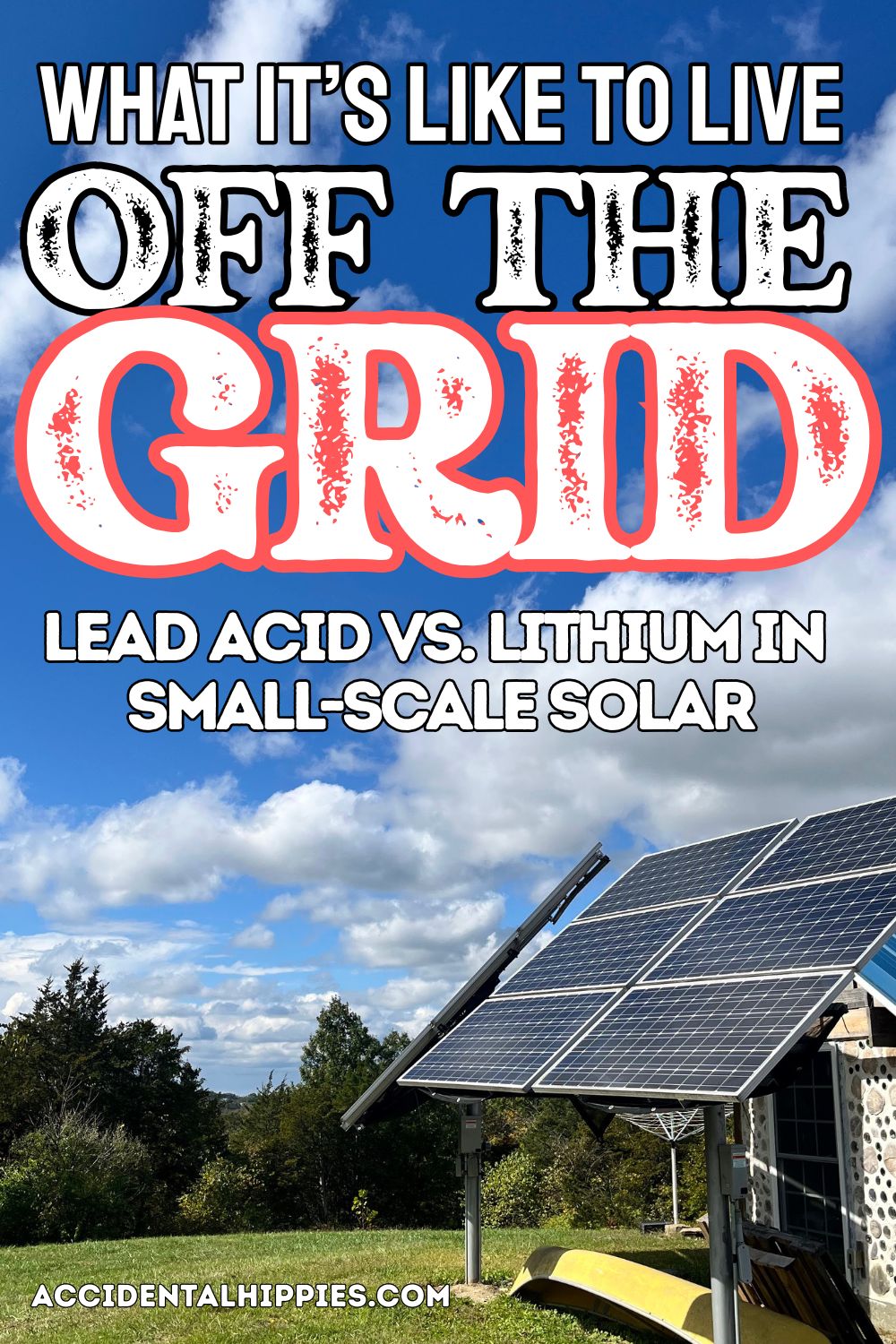
In this post, I’m going to take you inside what living with a small lead-acid system was really like, why we decided to upgrade the batteries, and what that meant for the system as a whole. I’ll also show you the ins and outs of what it means for our daily life living off the grid so you can see what it could be like for yours if you take this path.
The Limits of Lead-Acid Batteries
Lead acid is a tried-and-true technology that has been used extensively in off-grid systems for decades.
When we initially went off-grid, the company we ordered our solar kit through sent sealed lead-acid AGM batteries. AGM stands for Absorbent Glass Mat. In this design, the electrolyte (battery acid) is absorbed into specialized fiberglass mats between the battery plates, unlike traditional “wet” or “flooded” batteries that have free-flowing electrolyte. The result is a battery that is less prone to spills and leakage, which is ultimately safer.
Everyone we saw with flooded batteries mentioned having to fill them regularly to keep them working correctly and safely. We didn’t like the idea of having to babysit our battery bank, especially since we like to travel, so the sealed AGM batteries sounded like a good fit. There were some issues from the outset, though.
The Problems with Sealed Lead-Acid Batteries
First is lifespan. Sealed AGM batteries have a typical life of 4-8 years, with 3-5 of those being considered good service. Our first battery bank made it three years, but then got to a point where it wouldn’t hold a charge overnight.
Second is the depth of discharge. If you have a smartphone, you likely either know someone who runs their phone all the way down to 5% before they finally charge it, or you ARE that someone. You can do that with a phone because those batteries are typically lithium-based. You can’t do that with a lead-acid battery.
Lead-acid should be discharged no more than 50% (though some deep-cycle batteries can be an exception). Drawing more power than that can seriously shorten their lifespans, which is exactly what happened to us.
“Everyone always kills their first battery bank”.

This is something we’ve heard from loads of seasoned off-gridders, and it makes sense.
When you’re newly off-grid, you don’t know what kinds of charging habits you ought to have. You don’t truly know if your solar panels are giving a good enough charge to your battery bank on a regular basis. You probably let your battery voltage drop too low before recharging it via solar or your backup generator. And you probably put too many heavy power loads on it from time to time.
We did all of those things, so we took those lessons and applied them to our second battery bank. It was identical to the first one. The exact same specifications, same size, everything. Four UB8D sealed AGM lead-acid batteries. And this time, we made them last for five years.
Five is definitely better than three, but we had to charge them a LOT with our backup generator to get through their final winter. I don’t know about you, but if part of the appeal of solar power is sustainability, then there’s something deeply upsetting about running your gas-powered generator a few hours every single day for most of the winter.
Why We Switched to Lithium Iron Phosphate
We knew that we could get the exact same batteries again, but that felt like throwing good money after bad. They’d just do the same thing, and we’d get another 5 years out of them before we’d have to do it all over again.
We also knew that we wanted to increase the amount of power we can generate and use. Our previous systems were quite small, and knowing that we may want things like an electric or plug-in hybrid vehicle some day, we wanted to future-proof a bit.
At the time of this particular upgrade, in Spring 2025, the cost of lithium iron phosphate (LiFePO4) batteries was a better deal per usable kWh than the same sealed AGM batteries. What do I mean by “usable”?
Our UB8D batteries had 250 amp-hours each. On our 24V system, that was a 500 ah system with roughly 12 kWh of potential. But remember that you can only safely discharge it to halfway before you risk damaging it, so it’s really only 6 kWh of potential.
Our Battery of Choice
As part of our total system upgrade, we purchased six Midnite 5.12 kWh MNPowerFlo5 LiFePO4 batteries from Current Connected and put them in a lockable EG4 cabinet.
Midnite is currently designing their own cabinet, but at the time of this writing, it is not yet available. The EG4 cabinet is compatible enough, though not perfect. Either way, it is great to have the batteries fully enclosed and locked. I don’t worry about anyone bumping them or messing with them.
They have a 10-year warranty, so I’m pretty confident we’ll get more than 3-5 out of them. And when we do have to replace them, they’re relatively easy to move compared to our old UB8Ds. At 170 pounds, those things were beasts to move. The Midnites are still super heavy at nearly 100 pounds a piece, but at least they have sturdy handles, and the terminals aren’t exposed. They also have their own breakers, so you don’t have to work on them with live power, unlike the lead batteries we had. That was always nerve-wracking.
Inverters and Battery Management: The Other Half of the Story

48-volts is the standard architecture for an off-grid home, so we had been pretty undersold with our 24-volt system. Inverters are voltage-specific, and our new lithium bank would be the off-grid standard of 48-volts nominal, which was incompatible with our old Magnum inverter.
We liked the new Midnite The One All-in-One Hybrid Inverter due to its features, simplicity of installation, and Midnite’s track record as a company. There were many other brands we looked at, but for what we wanted the Midnite was a perfect fit.
Before we decided to buy it, Mark spoke directly with both technical support at Midnite and sales over at Current Connected to ensure that the system we were going to install would meet all of our needs. Between phone calls and emails, we received over two hours of free customer service before we ever paid a dime. That gave us a lot of confidence moving forward.
You can grab our free PDF solar guide that contains a script for starting these kinds of conversations with solar companies in our FREE resource library for email subscribers.
The Biggest Differences in Our Off-Grid Home
This jump to the Midnite All-In-One has totally changed the game for us. I keep saying that I don’t even really feel like I’m off-grid anymore because our power usage isn’t as pervasive a thought throughout the day.
Our old inverter only had the potential to send 4,000 watts to the house at any given time, with a surge potential up to 5,800 watts. If you’re running an air conditioner, a well pump, and a hairdryer, that’s enough to trip the system and turn everything off.
The Midnite All-In-One can send a whopping 11,400 watts to the house with a surge capacity close to 20,000 watts. So now that we’ve effectively tripled how much power we can pull, I don’t really worry about how many different loads are running all at once.
It can even set “smart loads” that only charge something once the battery bank is full, for example, an electric vehicle. Getting a plug-in hybrid or full electric is something I’d written off under our old system, but now it feels more realistic.
What We Can Do With a Bigger System
While we haven’t yet added more solar panels to our existing array (those are coming soon), the existing panels have had zero issues keeping up with our needs.
At the time of this writing, it is just past the summer solstice and we have had some oppresive summer heat. I have been running the air conditioner with reckless abandon without considering whether the battery bank is charged up enough yet or worrying about how cloudy it is.
I have given almost zero consideration to what loads are being used at the same time. We even bought full-sized versions of gadgets we’d previously been using little versions of to save power, chiefly a waffle iron and a clothes iron. It’s funny the little creature comforts that have been the most exciting so far. Who knew that we missed full-size waffles so much??
We want to see a full year of how our system behaves in different seasons before doing anything bigger, but a regular fridge and a mini-split AC are definitely on our wishlist.
Update October 2025: We had to get a new electric fridge earlier than anticipated. You can read all about those shenanigans here.
How We Used to Monitor Our Solar
If you live on the grid, you have to understand that the status of our solar system basically lives rent-free in our heads all day every day. It is emeshed into our routines in a way that your power usage just isn’t when you pay an electric company to make the power for you. Sure, you might tell your kids to shut the door because, “Dang it, I’m not paying to air condition the outside,” but it hits different when you’re responsible for ALL of it.
For the past 8 years, we’ve started each morning by checking system voltage. We used to lose a lot of power overnight—or at least it felt that way. If the batteries had gotten full (Float) that day, then at sundown, they’d settle around 25.5 volts (a bit higher in summer, lower in winter).
By morning, we’d be at 24.8v after a short summer night, or down to 24.3v after a long winter one. Some loads—like ARC fault breakers and smoke/CO detectors—run constantly, so there’s always some draw, even overnight.
If the voltage ever dropped to 23.9v, the Morningstar controller would skip the Float stage the next day to protect the batteries. And if it hit 23.0v, the inverter would shut down completely—our system’s “zero.” So 23.9v was our red flag. It meant we needed sun or a few hours on the generator. And as the batteries aged, holding voltage got more difficult, so we ran the generator a lot, mostly during the winter.
How we monitor now: from volts to percent

We were accustomed to thinking in terms of volts for so long, but the Midnite inverter shows the percentage of battery life, just like your phone or laptop might. It also shows the volts, but those numbers have almost no meaning to us, at least not yet. It’s not a strict doubling of what we were used to seeing, and to be honest, with the percentage on the display, the voltage is a bit of an afterthought.
We lose very little power overnight now. If we leave the basics on overnight (smoke/CO detectors, ARC fault breakers, maybe a couple of fans) we only lose 1% of our battery potential. During the most recent heatwave, we left the air conditioner on overnight for the very first time and only dropped by 12%. If we had done that on the old system, our system would have shut off well before morning. We’ve NEVER been able to do that before!
I’m sure that as the batteries age and we add more loads, like maybe an electric fridge, they’ll lose more overnight. But in the meantime, I’m going to revel in only losing a few percent. That’s a huge win for us.
Next Steps for Our Off-Grid Solar
An off-grid system has four basic parts: solar panels to generate power, a battery bank to store charge, a charge controller to manage the charge going from the panels to the batteries, and the inverter to send power to the house. We’ve now upgraded 3 out of 4 of those.
Phase one was to replace the batteries and charge controller/inverter. We knew that we could run those components using our existing solar panels, especially during the summer with long sunny days. They’ve had no trouble keeping the system full, especially with the summer sun. Even our cloudiest, rainiest days have had the battery bank at or near 100%. And while it feels like the Midnite is using our existing panels more effectively than the old system did, we can tell that we will need more solar panels for the system to work optimally in all seasons.
Phase two is to add more PV.
We purchased ten absolutely enormous solar panels from SanTan Solar during a recent sale and will put them up as two ground-mounted arrays. We are currently waiting on our mounting system and gravel to do that leg of the project.
These new panels are 535 watts a piece, which is way bigger than the 190w and 235w panels we’ve been used to. These panels are also bifacial, which is a really cool advancement where the solar cells can recapture some of the light bouncing off the ground behind them. I look forward to sharing more about that as we get to know and use them.
In the meantime, I invite you to dig into solar power a bit more, including some of our solar journey and some resources to help you with your own.
Keep Reading About Solar
- How to Get Started With Home Solar Power
- What We Do (and don’t) Run on a Small 1.14 kW Solar System
- Our Solar System Expansion from 1.14 kW to 3.26 kW
- Beginner’s Guide to Buying a Quality Solar Power Kit

Learn more about our original cordwood homestead project here. And be sure to join us on Pinterest, Facebook, and Instagram for more homesteading goodies that don’t necessarily make it to the blog. Thanks for reading!