Disclosure: I sometimes earn products or commissions from affiliate links or partnerships on my blog. I only recommend products and services I trust to serve you. Learn more.

Imagine with me…it was 2017, and we were working around the clock to finish our off-grid cordwood house so we could move in before winter set in. We’d just installed our first (quite tiny) solar power system with just 1140 watts worth of solar panels and a few lead-acid batteries. It was just about all we could afford to get started, but it was certainly enough to keep the lights on, run our computers and small appliances, and take care of basic home functions like the cistern pump and water heater.
Realizing the limitations of a system like this, we decided to go slow. We wanted to see how our power generation really went through the winter before buying any large electric appliances.
Good thing, too.
Our first winter was a learning experience, for sure. And one of the biggest things we realized was that, if we wanted to ensure we’d have enough electrical power during those short, cold winter days, we needed to keep our power loads to a bare minimum.
READ: Does Solar Power Work During the Winter??
Let’s take a look at the evolution of refrigeration in our own solar-powered home and dive into the nitty-gritty of it so that YOU know how to proceed with your own current or planned off-grid home.
- Our first frosty solutions
- Enter the Propane Refrigerator
- The Pros of Propane Refrigerators
- The Cons of Propane Refrigerators
- An Electric Fridge Off The Grid
- How the Electric Fridge Performs on Solar Power
- Lessons Learned
- Who SHOULD use a propane fridge?
- To sum up, YES you can run a standard fridge on solar power.
- Learn more about our life off the grid:
- Don't forget to grab your free PDF solar planning guide (and loads of other free resources!) below:
Our first frosty solutions
For the first couple of months we lived here, we literally kept our cold foods in coolers with ice. We tried to keep those items to a minimum, so we relied heavily on shelf-stable foods and limited leftovers. This worked for a little while, but was a very short-term solution.
I wish I could say that Kentucky winters are cold enough to keep food outdoors, but they just aren’t. The constant expense of bagged ice and fussing over the arrangement of items inside wore us down pretty quickly, but we persevered.
As spring approached and days got longer, we tried out a 4.5 cubic foot mini fridge to see what impact it would have on the solar system. This was a HUGE blessing, as it only used between 5 watts (while resting) and 95 watts (while cooling). You can see it in the bottom right of the photo below:

This barely made a dent in our power usage, thank goodness. But 4.5 cubic feet isn’t much to work with. I had as much space in my dorm fridge. This was hardly a long-term plan for a family of three.
So I started researching better options.
Enter the Propane Refrigerator

If we were going to have refrigeration off the grid, we realized it would have to be something besides a regular electric fridge. Our battery bank and inverter were relatively underpowered, and we knew that a fridge compressor surging at the same time as any of our other large loads, like the cistern pump, could trip the system and shut off power to the house.
Doing a search for “solar fridge” returned a lot of interesting results. If we had dropped a DC line to the kitchen, perhaps we could have run a super-efficient DC refrigerator, but we didn’t. My attention turned to the remaining non-electric options that popped up, and those were all powered by propane.
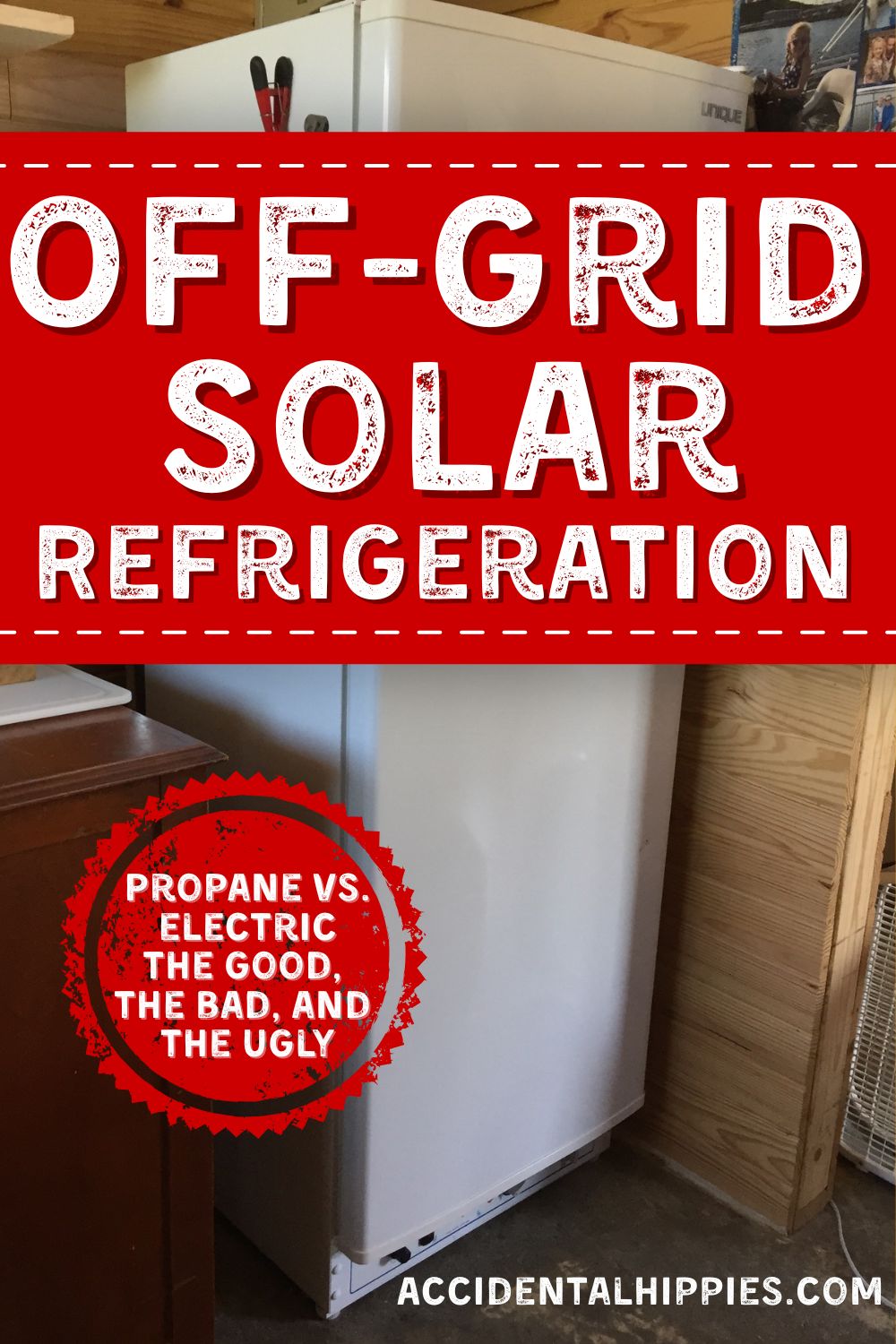
I searched loads of websites and read about a million reviews before I finally settled on a scratch-and-dent Unique 8-cubic-foot model from Ben’s Deals. I can’t say enough amazing things about THEM as a vendor of off-grid-friendly appliances and working with them to ship our item. However, that’s about where my elation ends.
The Pros of Propane Refrigerators
Before I launch into the many cons we discovered, propane does offer a couple of advantages over an electric refrigerator.
They are SUPER QUIET. They have no moving parts and no compressor, so they make zero noise when they run. The most you might hear is the sound of the pilot light, if that.
They’re not reliant on electricity. If you have no electricity or a very small off-grid power system and can’t rely on it to keep a standard fridge operating at a consistently safe temperature level, propane is a fantastic way to ensure your food stays cold.
Ours did have a 110v backup that allowed us to plug it in just in case we ran out of propane or something, which I ended up appreciating more than I’d anticipated, but NOT because we ran out of propane. More on that in a minute.
Unfortunately, this is about where my list of advantages ends.
The Cons of Propane Refrigerators
We had read so many glowing things about folks who had been operating the same propane fridge for 30 years. People touted their longevity! The lack of moving parts meant that parts shouldn’t wear out, right?
Right?? No.
Regular defrosting is a chore.
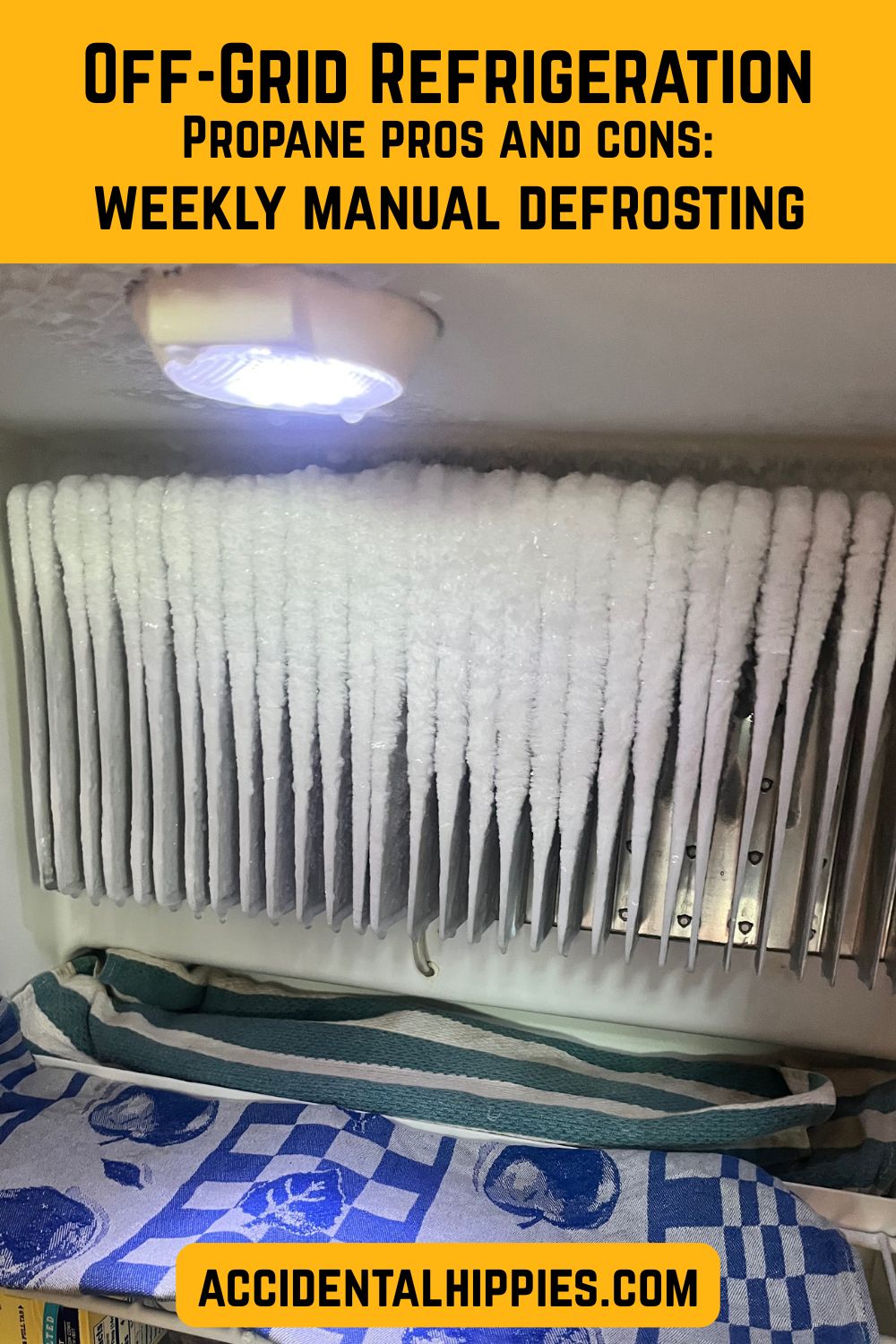
Propane refrigerators do not have defrost cycles like electric fridges do. They are designed to run constantly, so it is important to clear the frost buildup regularly.
I defrosted the fridge about once per week, typically the day before I’d do a grocery run so it was at its emptiest.
We always tried our best to follow the owner’s manual schedule and procedure for regular cleaning and maintenance, but we often had issues. For example, it was next to impossible to relight it after turning it off for cleaning or if we were going out of town for a while and wanted to let it defrost.
Since this fridge was so hard to relight, I usually just kept it running while I defrosted it each week, and put a stock pot of hot water on some towels on the top shelf next to the fins. I’d collect the run-off in a kitchen towel and pull any sheets of ice off the fins to put into the pot of water. When I was done, I’d let the water cool off and then pour it into our Berkey filter or do dishes with it so it didn’t go to waste.
The freezer only needed to defrost about 2-3 times per year.
I’d do one in the summer during a long vacation, where we could totally clean out the fridge and let the whole thing sit. I’d do another one in the dead of winter whenever we had a bad cold snap. In Kentucky, we can usually count on at least one good sub-zero spell in December or January, so I tried to capitalize on that so I didn’t have to buy ice or anything. I just set the food in the coolers outside until the freezer was ready to use again.
Propane Fridges are EXPENSIVE
Size for size, propane refrigerators are astoundingly expensive. Our Unique fridge was only 8 cu.ft., barely two of those mini fridges from earlier, and even buying it scratch-and-dent to save money was still a whopping $1200. You can buy an enormous conventional fridge with all kinds of bells and whistles for the same price. Heck, you can get an apartment fridge about the same size as our old one for $400-500.
The same unit NEW back in 2018 was around $1500-1600. Just for kicks, I went and looked up what it is now. $1,800 – 2,300. For real. You can find them for slightly less if you shop around, but really now…that much money for 8 cubic feet of food storage is staggering.
Temperature Control
Perhaps it was our particular fridge, I don’t know, but it seemed like it struggled to keep a consistent temperature through the seasons.
Being off-grid and running our air conditioner minimally, the fridge would ALWAYS struggle to stay cold enough in the summer, even at the coldest setting when properly defrosted. That was true even when we upgraded the solar and could run our AC day and night. It just didn’t matter — the fridge would struggle to stay anywhere close to 40. There were times it would edge towards 50, which is definitely not safe.
FYI: This fridge and freezer thermometer is how I keep track of how well the fridge is cooling.
Conversely, in the winter, the fridge would struggle not to freeze everything. Even at its warmest setting, the fridge was often 32-36 degrees. Items close to the fins would often freeze solid. It didn’t seem to matter how well we followed the best practices laid out in the manual. We could clean the back and defrost it regularly, keep enough clearance around it, and provide enough ventilation, and it wouldn’t care. Unless it was spring or fall, the poor fridge just struggled with consistency.
And this is important for off-gridders especially, because chances are good your off-grid space isn’t going to be perfectly temperature-controlled at all times. There will be seasonal fluctuations. Even if you have AC and heat like we do, there is some natural variation throughout the year.
For us, our summer indoor temps seem to hover around 75. In the winter, it’s more like 66-70. And even still, the fridge should not have been so wildly inconsistent. Food should be kept at a safe temperature, period. That’s the whole point of a fridge!
Parts Failures
Perhaps this was simply poor luck with our specific fridge or brand of fridge, but we ended up replacing SEVERAL parts on our Unique over the seven years we owned it. This included the thermocouple and electrode/wire. We also replaced the door hinge bushings with these metal ones after the plastic ones had worn through. We simply drilled out the old ones and slotted these metal ones in. Worked like a charm.

The door hinge issue was particularly annoying because it seemed like a relatively simple design flaw: the metal door hinges ate away at the plastic bushings. But when I contacted Unique to see about replacing them, they told me they didn’t sell those separately and would therefore have to buy an entirely new DOOR. Same for if I wanted to replace the door seal gasket, which definitely needed it as it had started deforming and not sealing all around both the fridge and freezer doors. The fact that these basic parts weren’t readily available was a source of great irritation for us.
To be fair, there are several other brands available, many of which have parts like the door gaskets more readily available than Unique. But still, propane refrigerators on the whole are simply more expensive than their electric counterparts and can often be more difficult to get parts for. Which leads me to my next point.
It’s hard to get a repair tech to look at it.
I’m pretty lucky that we can troubleshoot and do our own maintenance, but when our fridge finally stopped functioning this past August, we KNEW there were no repair technicians in our area who had any idea what to do with a propane fridge.
I had a feeling this would be the case when we first installed it. Despite the fact that our property is off-grid, we actually live in an area with a pretty decent population density and access to grid resources. In other words, most people around here can get away with normal appliances and standard household items.
As such, there are no techs who are even willing to look at a specialty appliance like this one. When the 30-year propane veteran who ran the flexline and hooked up our fridge for us said, “Wooo buddy, I’ve never even seen one of these before,” and then proceeded to read through the manual WITH us to make sure HE knew what he was doing, I knew we were on our own from that point on.
To be fair, I did call several repair outfits in the metro area to see what they might say, but none of them were even willing to come take a look. Our fridge was toast.
An Electric Fridge Off The Grid
Perhaps it is providence that we took all of this summer to upgrade our solar system. We expanded back in 2020 from our original 1140 watts to 3255 watts of solar, but both still had our small lead-acid battery bank. So this year, we switched over entirely to a new lithium system with well over 6,600 watts of power generation.
We had intended to wait a year to see how the system performed through an entire winter before getting any major electrical appliances. But in the last week of August, our hand was forced. Mere hours before my weekly grocery delivery (yes, we can do that off-grid), I discovered that the fridge was off and the burner would no longer stay lit.
We went through all the troubleshooting advice in the manual, scoured online forums, and called customer service, but to no avail. We had become so frustrated by our fridge that we thought this was probably our sign to go ahead and try a standard electric fridge.
The propane fridge had a temporary electrical backup option, so we plugged it in and frantically set to researching our options.
Finding a Conventional Fridge for Our Off-Grid Home
Even with the upgraded solar system, I knew we’d need a fridge that was as efficient as possible. With that in mind, I kept my search to units that used the fewest kWh per year but still in a size range to accommodate our family.
After years with just 8 cubic feet of storage space, I knew we didn’t need a LOT of room. In fact, I had grown to appreciate how a smaller fridge helped us limit food waste. After all, it’s hard to lose track of food in a fridge that’s only a few inches deep.
After researching and reading loads of reviews, I decided on this 14 cubic foot Frigidaire unit. Its EnergyGuide tag rated it at a trim 332 kWh per year, which works out to less than 1 kWh per day. Knowing what we’d been using up to that point with our air conditioner and other loads, I figured less than 1 kWh per day would fit right into our system’s tolerances.
I took a deep breath and clicked Buy.

Three days later, a big box truck rumbled up our long gravel driveway and unloaded our brand-new refrigerator. The delivery guys had SO many questions about the old fridge, as they had never seen anything like it. I was more than happy to answer, and even happier to watch them wheel it out of my house.
How the Electric Fridge Performs on Solar Power
I plugged the new fridge into our Kill-a-Watt to see what it was actually consuming. What I saw was ASTOUNDING.
You see, in all of the helpful Q&As for this fridge (and others) on the Lowe’s and Home Depot websites, most of the questions about wattage fall short. Most answers just reference the voltage it’s rated for (120v) or the Amps required for the circuit (in this case, 15 Amps). If you’re running a fridge on solar or with a backup generator, this information is only marginally helpful.
I wanted to know how many watts it uses at rest and while running, as well as any start-up surge for the compressor. THOSE are the figures that most impact our day-to-day with solar power. So for anyone wondering, here it is:
- Watts at rest: 5
- Watts while cooling: 75-130, generally for only a few minutes each hour
- Watts during a defrost cycle: 180-200, usually once or maybe twice a day for a few minutes
- Start-up surge: None, at least not that we can see. It just sort of quietly cycles on and off without much fanfare.
Turns out, we were worried about nothing.
The potential power surge of a compressor has, until now, been one of our biggest concerns with a small off-grid system. We assumed that, like our cistern pump, there would be a big jolt of power to get going.
But so far, this fridge doesn’t seem to show any such surge. If I’m watching the Kill-a-Watt when it starts cooling, it simply changes from 5 watts to 120-130 watts without any fuss. It will then run for a minute or so at 130, drop down to around 75 for a bit, and then turn off again.
We probably could have gotten away with this kind of fridge YEARS ago and been fine for the most part. It probably would have been more of an issue as our last set of batteries wore down, but honestly, this fridge is such a small load it wouldn’t have mattered nearly as much as we assumed.
I’m not sure how many times it cycles through the day, as even with cloudy days, it doesn’t seem to matter. Our batteries are full regardless, and this fridge barely puts a dent in our usage. In fact, it uses about as much power as the mini fridge I mentioned at the beginning of this article.
At night, it seems to cycle once an hour, and the only reason I know that is because you can see it in our inverter’s phone app. Those little peaks are the fridge running for about 5 minutes every hour until morning.

I’ve left the Kill-a-Watt plugged in for 28 days as of this writing, and the fridge has used 22.81 kWh in that time. This averages about .81 kWh per day. Less than a whole kilowatt hour per day?? That’s pretty awesome.
Lessons Learned
So far, having a regular fridge has been a HUGE blessing. I don’t miss having to defrost it every week before my weekly grocery run. I’ve also appreciated having enough depth to put things like a 9×13 baking dish. I’d sworn off making full-sized casseroles in our time living here because there just wasn’t enough room for it in our propane fridge.
But I also really value the time that we DID have a propane fridge. It forced me to think about food and energy consumption in a new way, and instilled some new frugal habits that have helped us reduce our food waste even with a bigger fridge.
The propane fridge also gave me an appreciation for self-sufficiency akin to what I feel about our solar system. Living off-grid means that YOU are the one responsible for keeping your systems going. There usually isn’t a tech you can call to come to your house to fix the problem for you — it’s up to you to be the expert on your systems.
Who SHOULD use a propane fridge?
Honestly, I don’t want this to completely sour you on propane fridges, as they really are one of the best options for certain scenarios. Propane refrigerators could be a great option if you:
- Live in a remote area with no electrical power, or;
- Have a very small off-grid power system
- Need a way to keep your food reliably cold
- Have reliable access to propane
- Are confident in your ability to perform regular maintenance and potential repairs with your fridge (it is more involved than a standard electric fridge)
That said, you need to have access to more than just a 20 lb. cylinder. We ran our fridge, stove, and water heater on propane and have a 500 lb. tank by the house.
Our model of fridge was supposed to consume approximately 1 gallon of propane every 3-5 days, so about 73-122 gallons of fuel per year, give or take.
We typically get a fill-up of around 280 gallons once per year, and since the fridge was a huge chunk of our usage, I’m assuming we’ll be able to stretch our time between fill-ups quite a bit more. Time will tell.
Brands to Consider
I really wanted to love our Unique. They seem to have a good range of product offerings and had decent reviews online. Maybe we just had bad luck with our unit. I will say that I had a hard time getting a hold of their customer service. And when I did, I was disappointed in the lack of replacement parts and options for keeping our fridge running. They are based in Canada, so perhaps our being in the US made a difference on that end. I’m not sure. If you’re Canadian, you may or may not have more luck.
Based on replacement parts availability, you may consider brands like Crystal Cold and EZFreeze. Ben’s Deals seems to have quite a few replacement parts for both, and Warehouse Appliance has quite a lot for EZFreeze. Both brands seem to have decent reviews from the various off-grid forum threads I’ve read over the last few years.
To sum up, YES you can run a standard fridge on solar power.
And in reality, even the bigger ones probably don’t use nearly the power you think they do. But if you need it, propane refrigerators CAN be a good option. Just know that they have their own quirks and drawbacks.
Learn more about our life off the grid:
- What We Ran on a Small 1.14 kW Solar System
- Upgrading to an All-In-One Lithium Power System
- Running Air Conditioning on a Small Solar System
- 9 Things to Know About Living Off-Grid
- What Does it Actually Mean to Live “Off the Grid”??
- How Much Solar Power Do You Need?
Don’t forget to grab your free PDF solar planning guide (and loads of other free resources!) below:
Learn more about our original cordwood homestead project here. And be sure to join us on Pinterest, Facebook, and Instagram for more homesteading goodies that don’t necessarily make it to the blog. Thanks for reading!
